
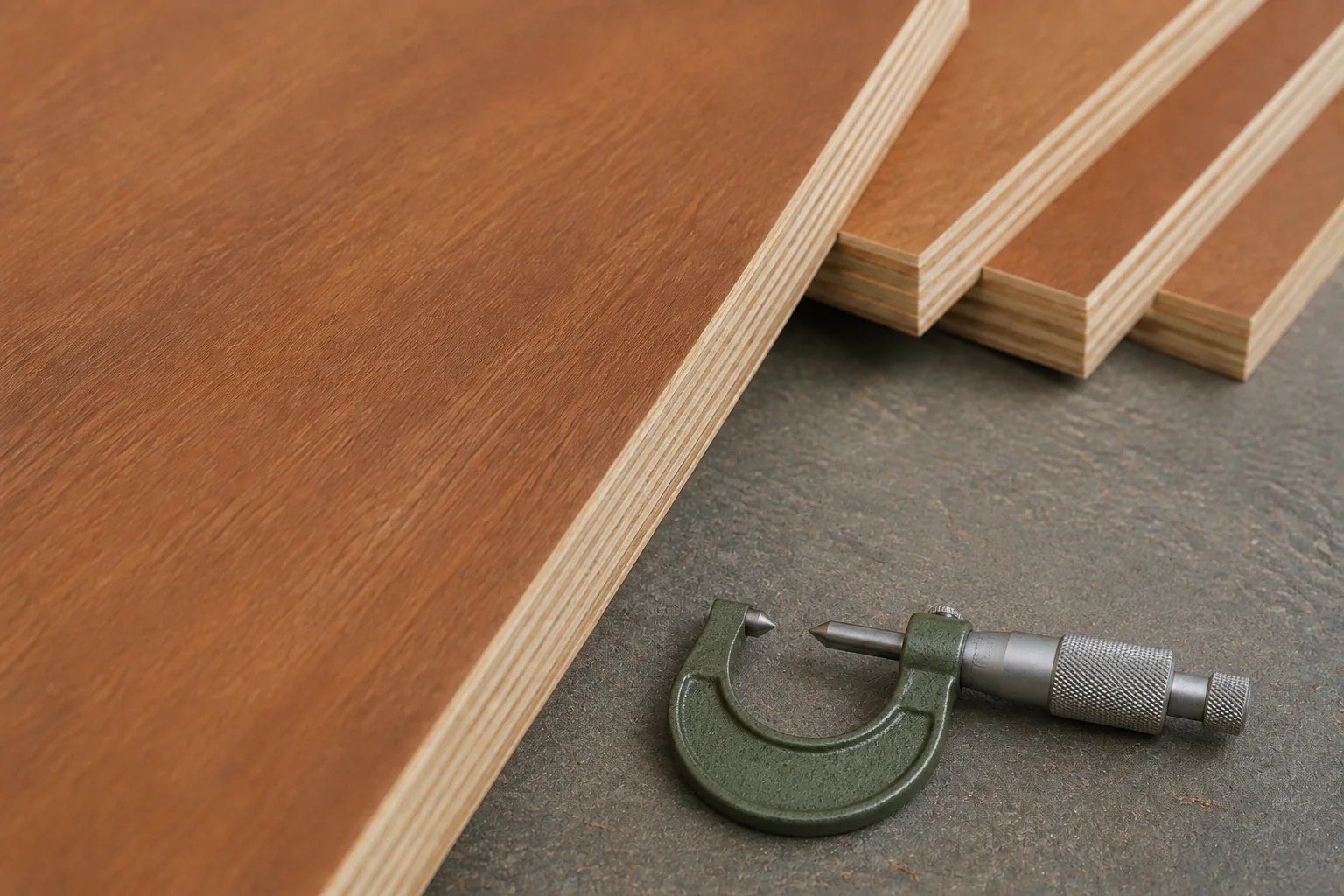
Short answer: calibrated Okoume furniture plywood controls thickness variation for machining and finishing. The E1 eucalyptus-core construction is a distinct enquiry choice; confirm finished thickness, tolerance and emission evidence for the product being quoted. An E1 class alone does not establish suitability for every furniture application or export market.
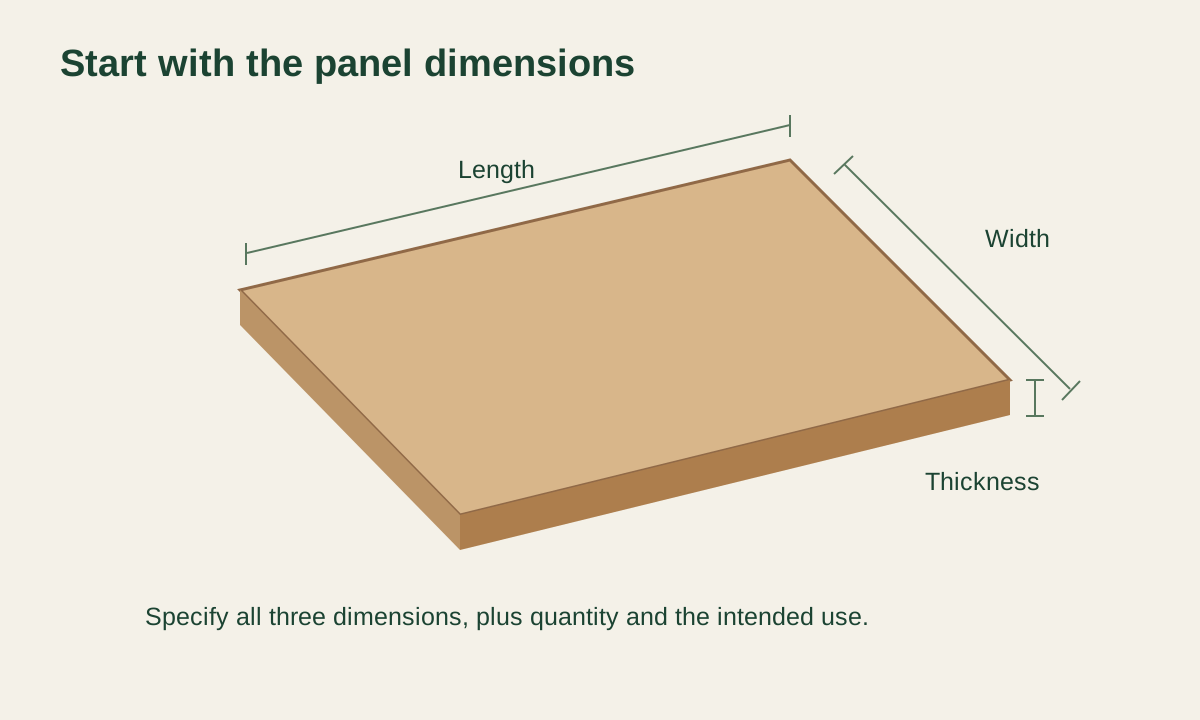
What "calibrated" actually means
Ordinary plywood is sold to a nominal thickness, but the real sheet can vary across its face and from sheet to sheet. A board labelled 16 mm might run a few tenths over or under. On manual work that variance is absorbed by hand. On an automated line it is not.
Calibrated plywood is sanded after pressing to a tight, consistent thickness — for our Okoume-faced furniture grade, about ±0.15 mm. Calibration controls variation within a tolerance; it does not make every sheet identical. Confirm the finished thickness, tolerance and measurement method on the quotation and check the received panels against them.
Why the tolerance matters on a production line
Tight tolerance shows up as fewer stops, less rework and a cleaner finished panel. Three places it pays off directly:
- CNC nesting and boring. Router depth and dowel-hole geometry are set once. A consistent gauge means the cut and the bore land where the machine expects them, sheet after sheet.
- Edge-banding. The bander references the panel edge. Thickness drift causes glue-line gaps and proud or sunken bands that need sanding back. A calibrated edge feeds clean.
- Lamination and pressing. Even thickness gives even pressure across the platen, so the laminate or veneer bonds uniformly without thin spots or telegraphing.
If your shop still works panel by panel with hand tools, you will see less of this benefit. The tolerance earns its premium where machinery, not a person, is holding the reference.
Okoume is a face, not a bond
Okoume is the face veneer — smooth, uniform, pinkish-cream — that gives a clean surface for lacquer or laminate. It is not a bonding or moisture grade. The core and the glue line are specified separately. Our furniture grade pairs an Okoume face over a Eucalyptus core.
That distinction matters when you compare quotes. "Okoume plywood" tells you about the show face, not how the panel is built underneath. Always confirm the core and the bond alongside the face. For how the face options sit on our commercial range, see Okoume-faced commercial plywood; for the wider grade, see commercial plywood.
E1: check the class, method and destination
E1 is an emissions classification that must be read with its product standard and test method. Ask for evidence identifying the offered construction, sample and test conditions. The E1 eucalyptus-core choice should not be confused with the separate hardwood BWR construction on the Okoume product page.
For covered furniture and wood-based articles placed on the EU market after 6 August 2026, REACH Entry 77 sets a formaldehyde-release limit of 0.062 mg/m³ under Appendix 14 conditions. E1 or CE wording alone is not proof of that requirement. Scope and conditional exemptions depend on the article and its intended use; confirm them with the importer. See our destination emissions guide and the official Entry 77 text.
For other markets, identify the applicable rule or certification at enquiry stage, including US CARB or TSCA Title VI requirements where relevant. Supporting reports and documents must match the offered product and be confirmed in the quotation. The current technical data sheet describes the product choices; it is not a destination-compliance certificate.
Bare or HPL-laminated — and a number not to confuse
The grade is available bare or HPL-laminated. Bare board suits shops that laminate or lacquer in-house. HPL-laminated arrives with the decorative surface already pressed on.
One figure trips buyers up: a "16.5 mm" laminated sheet is the finished thickness after HPL, not the bare board. The bare board underneath is the nominal gauge; the HPL adds the rest. When you spec or compare, be clear which number you mean — bare board thickness or finished laminated thickness.
Reference spec and a quick fit check
A 16 mm Eucalyptus-core sheet runs about 32 kg, which works out to roughly 672 kg/m³ density — a solid, consistent panel, useful when you are planning container weights for an export load. Density varies with thickness and core, so it is confirmed on the TDS for your spec rather than assumed across the range.
Use this table to decide whether the calibrated grade is the right call:
| Your situation | Calibrated Okoume E1? |
|---|---|
| Automated CNC / edge-banding / lamination line | Compare the quoted tolerance with the machine requirements and assess the finished panels. |
| Lacquer or laminate finish over a clean, uniform face | Confirm face quality and compatibility with the intended coating or laminate. |
| Furniture or interiors, emission limits apply | Check the applicable limit, product construction and matching test evidence; E1 alone is not a complete approval. |
| Export market with formaldehyde limits | Identify the destination rule, article and end use; confirm the required report or certification before ordering. |
| Hand-built, rough-carcass or hidden structural work | Follow the application and design requirements; a generic panel label does not establish structural suitability. |
| Wet or exterior exposure as the main concern | Assess the full construction, bond, protection and installation requirements for the exposure. |
When a standard grade is the better buy
The calibrated E1 grade is not the answer to everything. For sheltered, non-structural interior components where appearance and close thickness control are not specified, compare an ordinary panel against the actual requirements and quotation. And if your real concern is moisture or exterior exposure, that is a bond-and-core question — calibration and face veneer will not solve it. Match the grade to the actual job, and reserve the calibrated Okoume for the panels where tolerance and finish genuinely earn it.
When you are ready to spec a job, tell us your sizes, thicknesses, bare-or-laminated, and quantity and we will put the right grade in writing.
FAQ
What thickness tolerance should I expect from calibrated Okoume plywood?
The reference tolerance for the furniture construction is about ±0.15 mm. Confirm the finished thickness, tolerance and measurement method for your order. Machine setup and finishing compatibility still need to be checked against the actual panels.
Is Okoume a type of plywood or a face veneer?
A face veneer. Okoume gives a smooth, uniform, pinkish-cream surface for lacquer or laminate, but it does not define the core or the bond — those are specified separately. Our furniture grade is an Okoume face over a Eucalyptus core. See our FAQ for more on grades and faces.
What does E1 mean, and why does it matter for export?
E1 is an emissions class under a specified test framework, not a universal export approval. Check the actual article, end use and destination requirements, including EU Entry 77 where applicable. Confirm the necessary product-matched evidence before ordering; our emissions guide explains the separate checks.
Does the "16.5 mm" figure mean the bare board is 16.5 mm?
No. A 16.5 mm laminated figure is the finished thickness after HPL is pressed on — not the bare board. Always confirm whether a quoted number is bare board thickness or finished laminated thickness.
When is the calibrated grade not worth it?
For non-structural interior work without a specified face or close thickness requirement, compare the offered ordinary construction with the job requirements and quotation. And if moisture or exterior exposure is your real concern, that is a bond-and-core decision, not a calibration one.