
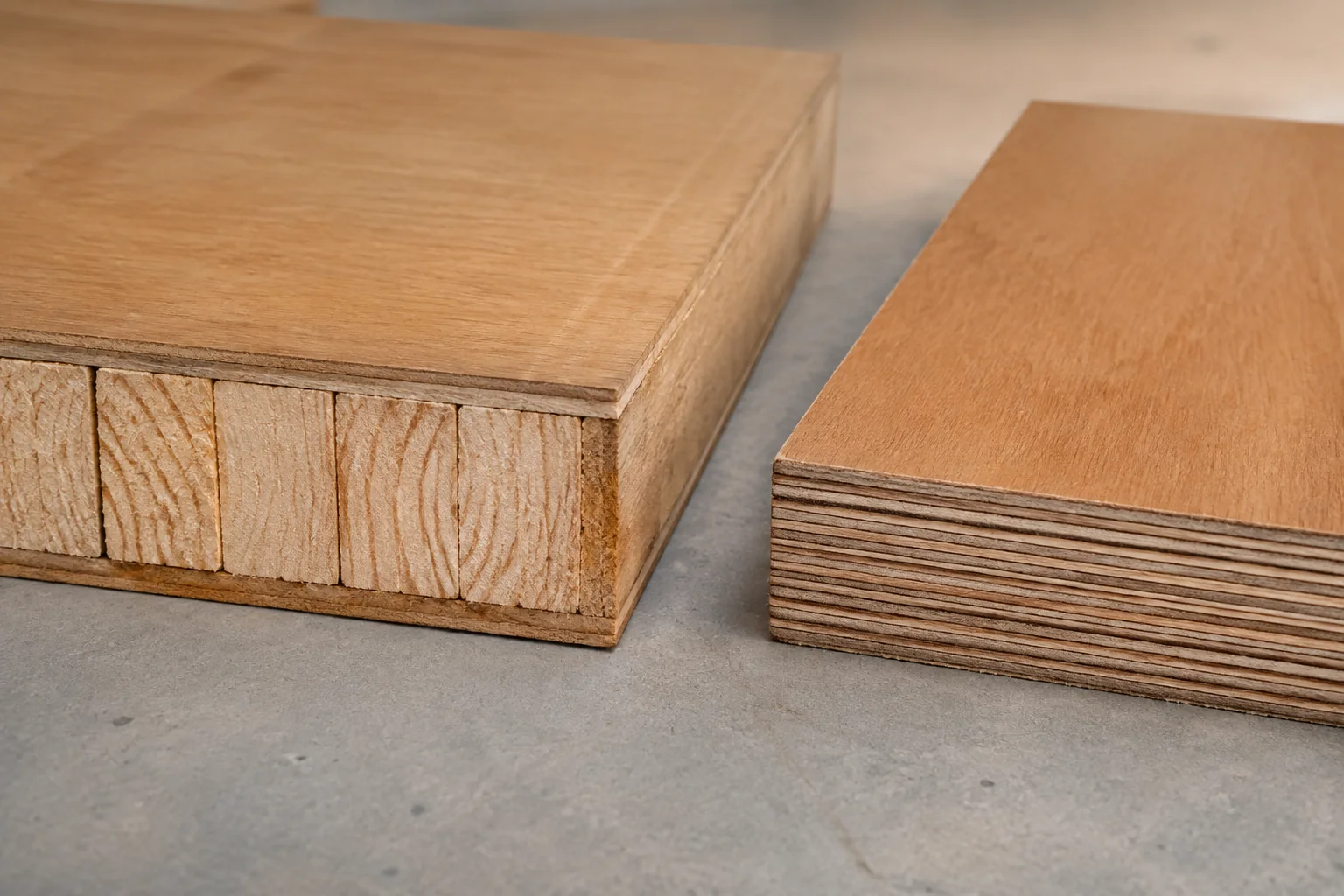
Plywood uses layers of wood veneer; block board uses a timber-strip core between face layers. Choose between them using the finished panel specification, support arrangement, finish and intended use. The material name alone does not establish strength, flatness or suitability for structural work.
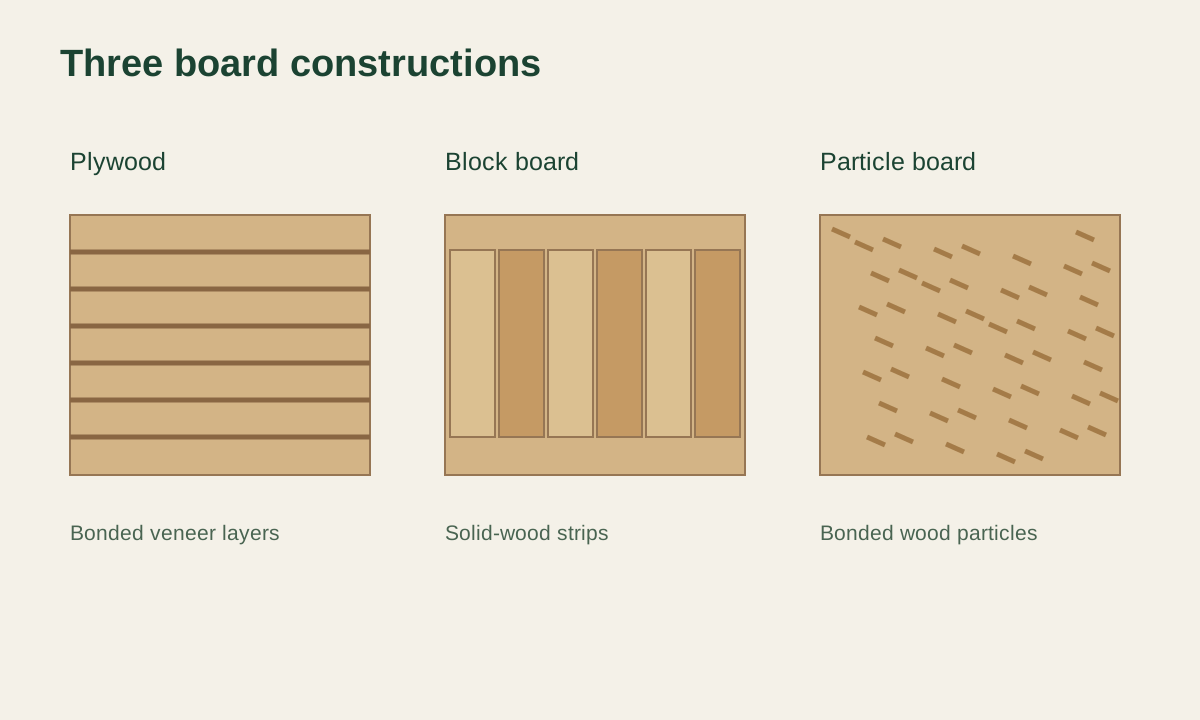
How the constructions differ
Plywood generally has veneers arranged with adjacent grain directions crossing. The layer arrangement, species, thickness and manufacturing specification affect its properties. Strength and stiffness can differ with panel direction; cross-lamination does not make every plywood equally strong in every direction.
Block board has a core of timber strips with covering veneers. Core material, strip construction, facing layers and bond specification affect weight, stiffness and fixing performance. Confirm those details for the offered product instead of assuming it is always lighter or more resistant to sagging than plywood.
Compare the actual panels
| Buying question | What to compare |
|---|---|
| Will the panel carry a load? | The required design, span, supports, direction and evidence for the offered construction. |
| Is it a door, shutter or partition? | Finished dimensions, core, facing, hardware, edge details and any specified door performance. |
| Will it be exposed to moisture? | The required bond/product specification, exposure, protection and maintenance. |
| Is weight important? | The quoted panel weight for the actual thickness and construction. |
| How will it be finished and fixed? | Surface, edge quality, tolerances and the installer's fixing and finishing requirements. |
Doors and shelves
For a door or tall shutter, send the finished size, facing, hardware and installation requirements. A block board panel and a finished flush door are separate order items. Our block board and flush-door page distinguishes pine and semi-hardwood choices and their enquiry dimensions.
For shelves and tabletops, specify the span, support arrangement and intended load. Neither a block board label nor a plywood label guarantees that a long panel will remain flat or avoid sagging. The designer should confirm the required construction and supports.
Moisture and structural requirements
Read the full product standard alongside MR, BWR or BWP bond terminology. BWP does not automatically mean marine plywood. The BWP and BWR comparison explains the distinction.
Structural work, formwork, vessel construction and container-floor repairs require the material specified for the complete application. Do not substitute a furniture panel based solely on its thickness or appearance. Use the relevant product page and project specification to prepare an enquiry.
Questions buyers ask
Which material is stronger?
Compare evidence for the actual products in the relevant direction and support arrangement. There is no universal ranking covering every plywood and block board construction.
Which costs less?
Compare written quotations for the same dimensions, construction, finish and delivery scope. Material names alone are not a price comparison.
What should I send for a quotation?
Send the application, drawing or cutting list, finished thickness, face and core requirements, quantity and delivery point. Include any required standard and supporting documents.
Request a panel quotation with that information. Availability, construction and terms are confirmed in writing.