
Commercial plywood · core guide
Rubberwood core in commercial plywood.
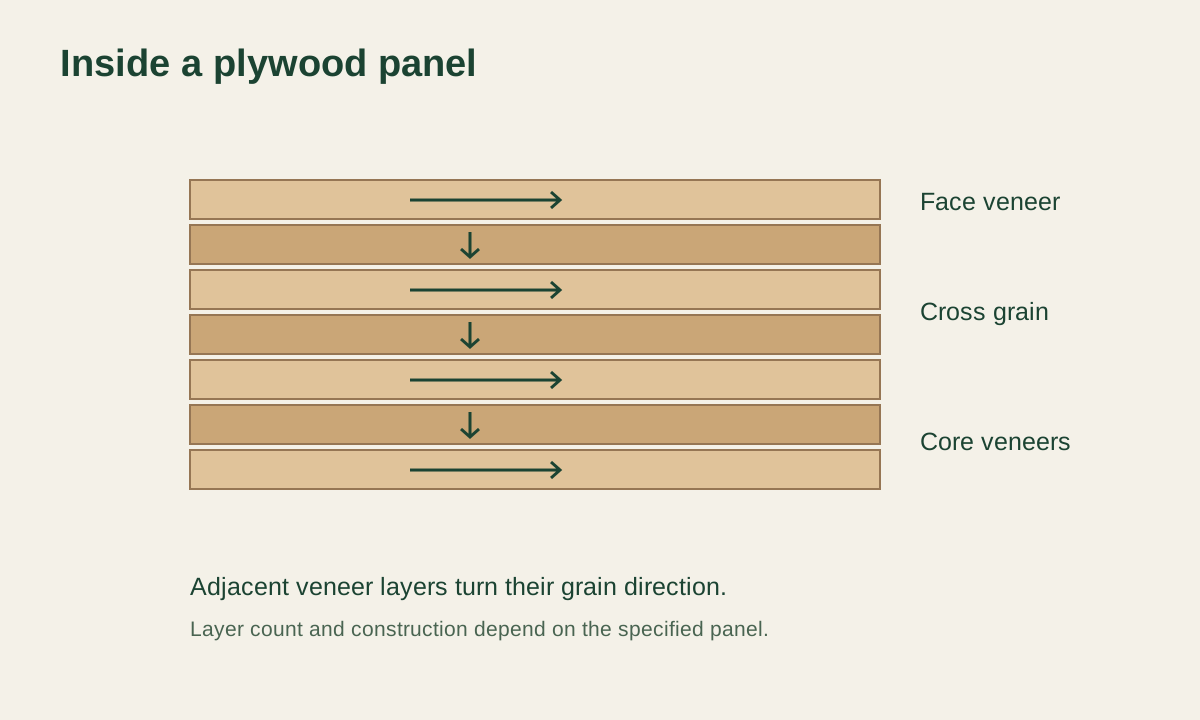
Our standard commercial plywood (also called packing-grade plywood) uses a rubberwood core and MR bond. This page explains that construction, supplied in the standard 6–18 mm range with occasional thicker sizes against order. We confirm the face, bond, finished thickness and application on the quote. Made in our factories in Perumbavoor, Kerala. In timber since 1986.
By Edwin David, Director, Cochin Wood Industries — manufacturer of plywood, packing cases and timber, Perumbavoor, Kerala. · Last updated 23 September 2026.
The hardwood Kerala peels more than any other.
Cochin Wood Industries is a rubberwood plywood manufacturer and exporter in Perumbavoor, the Kerala cluster that turns more rubberwood into plywood than anywhere else in India. Rubberwood is the timber of the para rubber tree (Hevea brasiliensis) — a plantation hardwood that is felled and replanted on a roughly 25 to 30 year cycle once its latex yield falls, so the raw material is farmed rather than taken from forest.
The cluster standardised on it for good reasons: steady plantation supply on our doorstep, a clean peel that gives even veneers, and a medium density that takes MR and BWR bonding well. That is why the packing and commercial plywood shipped out of Perumbavoor is, more often than not, rubberwood at its core.
Materials & applications
Choose the panel for the job.


Why the weight matters for your freight.
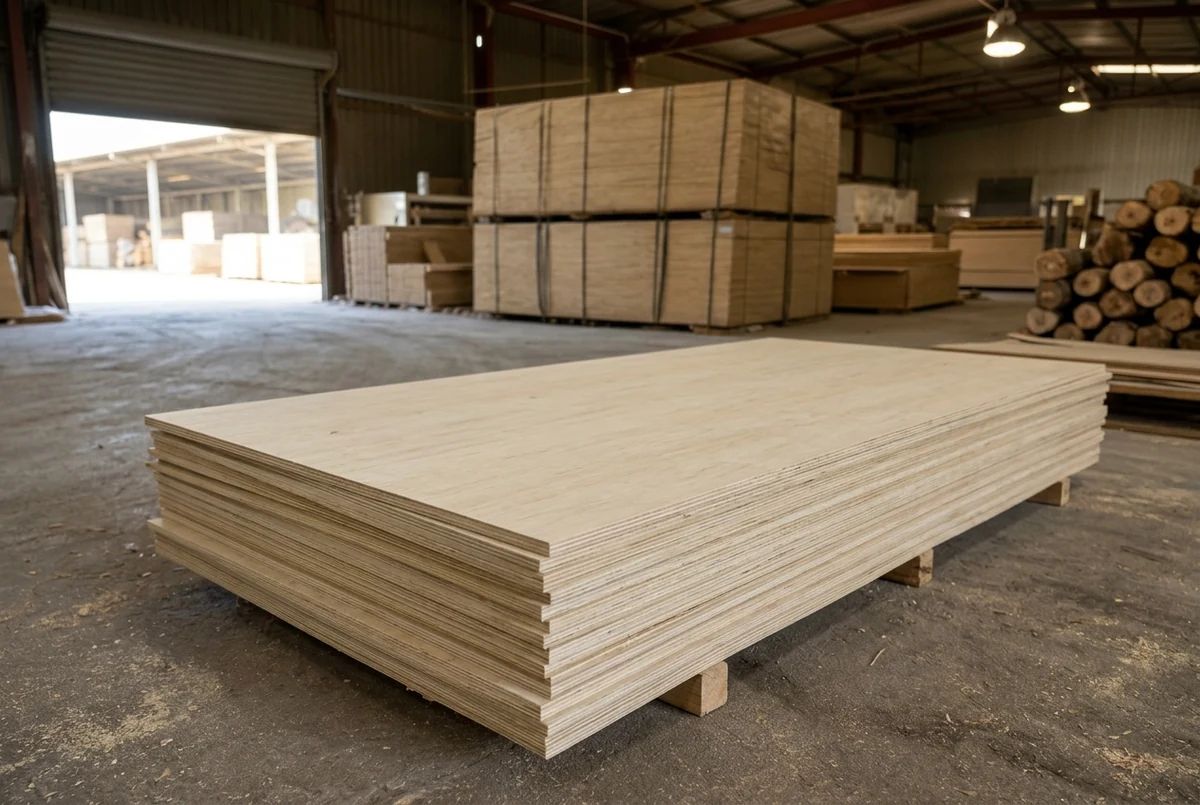
Rubberwood is a medium-density hardwood, so a rubberwood panel weighs less than a dense-hardwood or gurjan-cored panel of the same thickness. That difference matters when weight is the binding limit: with dense panels, or a low axle or destination road-weight cap, a lighter panel lets you load more usable sheets within the same weight limit, a direct freight saving on every sq ft shipped. When the sheet layout sets the count first, as in the flat-stack examples on our container load estimator, a lighter panel lowers the gross weight at the same sheet count instead.
We work the arithmetic on our rubberwood plywood container-weight guide, and price and load export orders around it on the export desk.
Grade and bond, stated up front.
Our standard rubberwood range is MR-bonded to IS 303 — moisture-resistant, pressed for structure, and the grade most packing and general-commercial work asks for. Where the service is humid or splash-prone we make a BWR-bonded panel to order. Rubberwood is the standard core; any eucalyptus-core alternative is named on the quote. Faces are commercial by default, with Okoume or Gurjan on request. Packing and commercial grade runs on minus tolerance — a nominal thickness may finish slightly under, never over — and we state the tolerance band on the quote so there is no argument at delivery.
Thicknesses and typical uses.
The packing range includes 6 mm, 8 mm, 10 mm, 12 mm, 14 mm, 15 mm, 16 mm and 18 mm quotation choices. Requests for nominal 7 mm, 9 mm and 17 mm are assessed separately, alongside occasional 19, 20, 22, 25, 30, 35 and 40 mm requirements. The written quote confirms availability, quantity, finished thickness and minus tolerance.
| Thickness | Typical use |
|---|---|
| 6 mm | Liners, lids, partitions, cladding |
| 8 mm | Light boxes and inner walls |
| 10 mm, 14 mm and 16 mm | Packing and general commercial requirements; confirm finished thickness, application and availability on the quote |
| 12 mm | General cases, commercial panelling, box walls |
| 15 mm | Heavy cases and crate walls |
| 18 mm | Bases, decks and point-load crates |
| Nominal 7 mm, 9 mm and 17 mm | Separate enquiries; state the minimum finished thickness and confirm the exact construction before order |
A trade label with a second thickness or a plus sign must be explained by a finished measurement and tolerance in the quote. Nominal 7 mm, 9 mm and 17 mm are not automatic substitutes for 6 mm, 8 mm and 16 mm. See the commercial packing thickness guidance.
Packing-grade rubberwood ply is quoted per thickness, ex-factory across the standard 6–18 mm range, with occasional 19, 20, 22, 25, 30, 35 and 40 mm sizes against order; GST and transport are extra. Rates move with log and veneer cost, so current pricing is confirmed on enquiry. Our plywood price guide sets out how thickness, grade and freight build into a landed cost, and our Perumbavoor market commentary reads what is moving the cluster.
Where rubberwood plywood earns its place.
Most of what we make goes into packing cases, crates and pallets for exporters and case shops, where the weight advantage and a bond that ignores transit humidity matter more than a polished face. The same panel can serve suitable general work. An Okoume face can also be specified on interior plywood; the chosen core, bond and any calibration are quoted separately. If you are crating for shipment, note that plywood panels are ISPM-15 exempt; only solid-wood crate members need ISPM-15 treatment and marking, where the destination requires it.
Common questions
Is rubberwood plywood waterproof?
Our standard rubberwood plywood is MR-bonded (moisture-resistant) to IS 303 — it stands up to transit humidity and damp handling but is not for permanent water immersion. For humid or splash-prone service we make a BWR-bonded rubberwood panel to order.
What thicknesses of rubberwood plywood do you make?
Enquire for 6 mm, 8 mm, 10 mm, 12 mm, 14 mm, 15 mm, 16 mm or 18 mm. Nominal 7 mm, 9 mm and 17 mm requests are assessed separately, as are occasional 19, 20, 22, 25, 30, 35 and 40 mm requirements. The quote confirms availability, finished thickness and minus tolerance; a nominal trade name is not a finished-thickness guarantee.
Is rubberwood plywood good for packing and export?
Yes. It is the grade most packing cases, crates and pallets are built from. Because rubberwood is medium-density, a panel weighs less than dense-hardwood ply of the same thickness. That lowers container weight, and adds sheets only where weight rather than the sheet layout is the binding limit. Plywood panels are also ISPM-15 exempt.
Do you export rubberwood plywood, and from where?
Yes. We ship from Kochi to 28 countries across six continents, quoted FOB. Country-specific terms are on our export pages; send your spec and destination for a written quote.
Tell us the spec, get a written quote.
Send thickness, monthly quantity and delivery location and we will come back with a written quote — usually within one business day. We supply in full truckloads pan-India and export from Kochi to 28 countries across six continents.
Choose your construction
Start with the product version.
Select a version to carry its name into your enquiry. Add thickness, size and quantity; availability and final specification are confirmed in the written quotation.